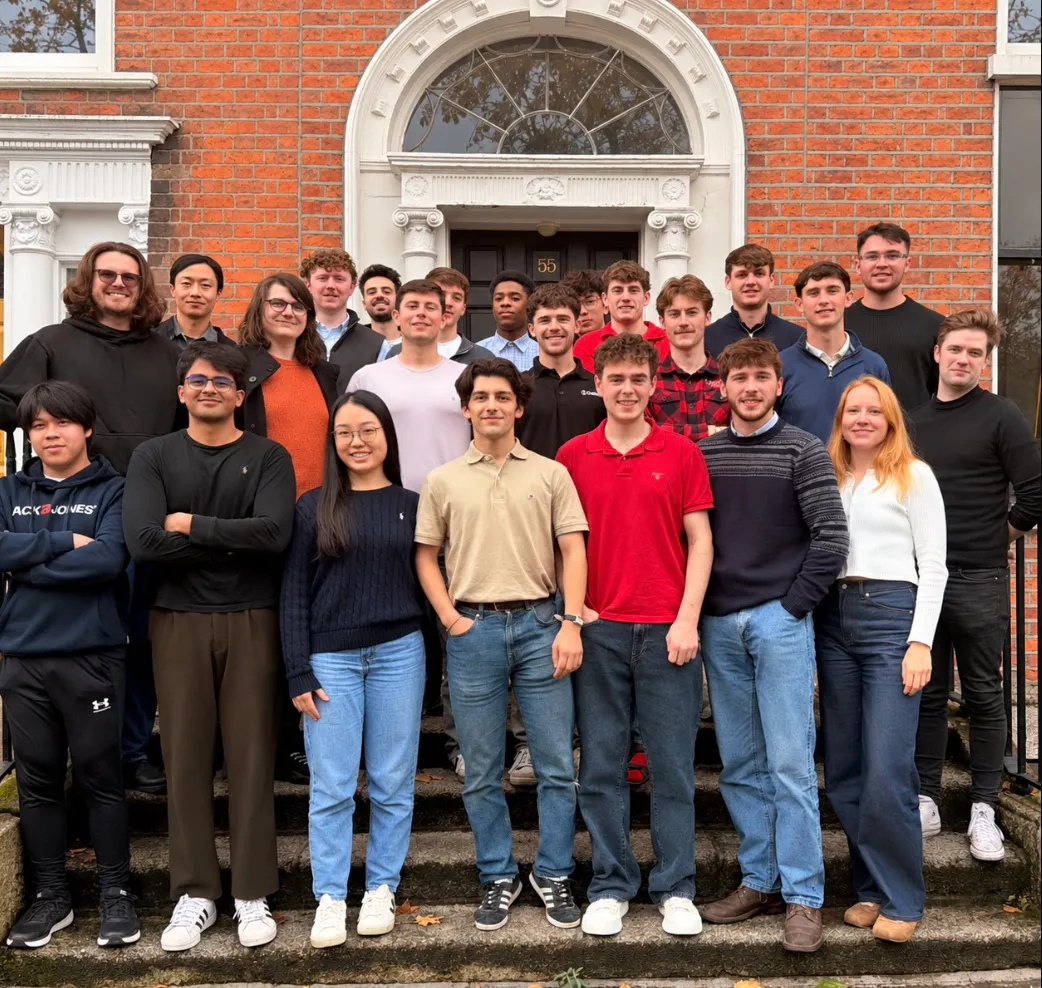
Dubsof is building the infrastructure for economic coordination. Our platform, Silkrun, connects businesses, generates the bespoke software each one needs, and gives their teams and agents one system to run the business from.
We’ve raised $6.5 million to take Silkrun to general availability, doubling our team in Dublin.
Our mission
Dubsof exists to build a better economy by solving coordination between people and companies. Most working time goes on admin and coordination. We want people to spend it on the work only they do best.
Inside a company, coordination means someone reading an email and typing its contents into another system, and someone else ringing around to find out which of two systems is right. Between companies it gets worse; a buyer and a supplier each keep their own record of the same order, delivery and invoice, and each side keys the other’s documents into its own system. Accounts payable teams run a three-way match between the purchase order, the delivery note and the invoice because none of the three can be trusted on its own.
Software has mostly sped this work up, but each new tool also keeps its own copy of the facts, so the number of records to keep aligned tends to go up. Large companies pay for ETL pipelines and integration teams to hold them together. For a company with a small office team that rarely makes sense, and very few of those companies have ever had software built around how they actually work.
The economics behind this are old. In 1931 Ronald Coase, then a student at the London School of Economics, went to the United States to visit factories. He wanted to know why firms exist if prices coordinate the economy. His answer, setting off the field of Transaction Cost Economics and published in 1937 as The Nature of the Firm, was that using the market costs something (it’s also a great read!). You have to find people, agree terms, check the work and settle disputes. Where that costs more than hiring people and directing them, you get a firm.
Our claim is that software can make coordination which once required common management available without common ownership. A company should be able to work with its suppliers and subcontractors as closely as it works with its own departments. Uber did a version of this for one industry, moving the coordination of drivers, dispatch, pricing and payment into software. Our goal is to do it across industries.
Silkrun gets there in steps. We start by focusing on the company, by importing its registry record and its people from the org chart, ingesting its existing data, and generating the applications needed on one shared data model. eg. An order is the same order in sales, production, delivery and billing.
When a buyer and a supplier are both on Silkrun, the purchase order, the invoice and the payment are one object, with separate rights for each side. An accepted change reaches both at once, and payment can be tied to accepted delivery.
Every person has their own space and agent, and so does every company they belong to. The agent works towards objectives, such as winning a contract or getting the finances in order. It already has the context because it lives where the work happens. Anything that needs judgement comes back to a person to approve or deny.
We’ll know this is working if three things hold with real customers. 1. People spend less time reading, typing and matching records per completed operation, after counting setup and supervision. 2. The same team supports more business where admin was the constraint. 3. Independent firms share an operation on one record and keep trading on it.
Where we are
After a year building in stealth, Silkrun is in beta and live with selected customers across industries, from construction and haulage to food production and manufacturing. We have more demand than we can take on.
Stanley Asphalt, a road surfacing contractor, ran its fleet, scheduling, compliance and office work from a whiteboard. It now runs on one live system, so its crews can see what’s coming without ringing anyone. The case study is on LinkedIn.
We closed $6.5 million over the summer from BlueYard, Backed, Project Europe and Cocoa. Project Europe is backed by 215 of Europe’s leading founders. Our angels include David Singleton, who built and leads Muse at Meta Superintelligence Labs and was previously CTO of Stripe; Matt Fitzpatrick, CEO of Invisible Technologies and former global head of QuantumBlack Labs at McKinsey; Dylan Collins, founder of Demonware and SuperAwesome; and Jack Cantillon, Mark Maxwell, Chris Mairs and others.
The funding takes Silkrun to general availability and lets us double the team.
Why join us
We’re doubling the team over the next months, with the focus on software engineering and machine learning.
Generating complete software that a real business can run on is one of the hardest open problems in applied AI. A business can’t run on software that is right most of the time, and better models alone won’t get there. The foundations have to change, so the system catches mistakes by design instead of relying on the model to avoid them. Our essay Vibe Coding Is an XY Problem sets out the argument.
Around that sit the problems the team works on day to day.
- Generation. We generate complete backends from a typed graph, and each generation step sees only the context it needs. The aim is output that is correct on the first pass, whichever model sits underneath.
- Importing a company. Real data arrives as spreadsheets, PDF accounting exports and email. It has to be normalised, split into coherent slices, matched to a schema and migrated in dependency order. Someone at the company then has to be able to accept what the system says is true.
- One record with several owners. A shared order needs permissions, versioning and approval rules that hold across two companies with different interests.
- Agents with authority. An agent has to know what it can see, what it may change and what counts as a finished action. It also has to recognise what it can’t safely settle and hand that back to a person.
- Running everything. Every customer’s apps run in isolation, are maintained centrally and get each fix the day it ships.
- Reaching legacy systems. Desktop software with no API, email and the phone all need to be wrapped so the agent can work through them.
Every role is full time and in person at our office on Merrion Square in Dublin. We’re hiring for core software engineering, full-stack engineering, infrastructure engineering, product design and TechOps engineering. We’re also growing our sales and customer delivery teams. All open roles are at eng.dubsof.com/careers.
Thank you to BlueYard, Backed, Project Europe and Cocoa, and to everyone who backed us early. Thank you most to our first customers, who let us into their businesses before there was much to show them.
Aidan